Outpost building strategy game Star Trek: Outposts Unknown launches October 20

Read the full article on GamingOnLinux.

Kingdom III: Rising Realms, Bye Bye Bonnie and more fun stuff revealed by Raw Fury

Read the full article on GamingOnLinux.
PvPvE extraction-style raid shooter Active Matter arrives September 15

Read the full article on GamingOnLinux.
Grab some more hits in the Beyond the Metroidverse Humble Bundle

Read the full article on GamingOnLinux.
Roll Out the Cake: Linux Turns 35
35 years ago, a Finnish student began a humble project that would forever change the course of technology.

1047 Games stop development on EMPULSE and SPLITGATE: Arena Reloaded

Read the full article on GamingOnLinux.
Dead by Daylight will be testing out Denuvo Anti-Cheat and other systems soon

Read the full article on GamingOnLinux.
MT7902 / mt7921e: severe download packet loss and low throughput under load on Fedora 44

Alien Deathstorm from Rebellion has a new trailer and release set for Spring 2027

Read the full article on GamingOnLinux.
VR co-op heist game PAYDAY: Aces High is being 'developed for Steam Frame'

Read the full article on GamingOnLinux.
Interesting hypothesis on why people are harder on Linux than Mac OS for being different, courtesy of my tech-illiterate (but pretty darn smart) mother.
Sometimes you know something, but due to the way that the brain compartmentalizes information, your brain still fails to connect the dots. For most people, the operating system IS the computer. People can tell when they aren't running Windows, but they don't think about it as running Windows on a computer. They think about it as just running a computer. So the idea that the computer would behave differently on a different OS might not fully register to them, even if they know they're running a different operating system.
Compare that to buying a Mac, it's a completely different computer, complete with different buttons on the keyboard. Naturally, this carries the expectation that it's going to behave a little differently.
Putting Linux on the
Hollow Home is an upcoming narrative survival RPG set in a city under siege

Read the full article on GamingOnLinux.
Hollywood Hustle: A Prop Collector Simulator has a fun idea for a scavenging clean-up sim

Read the full article on GamingOnLinux.
Blood Dungeon review

Read the full article on GamingOnLinux.
Why Your Backups Are Too Big: A Practical Guide to Content-Defined Chunking
By Gilles Chehade You change one line in a large file. Your “incremental” backup re-uploads the whole thing anyway. Nine times out of ten, it’s not the network, and it’s not your storage backend. It’s the algorithm deciding where to cut your data into pieces. Every deduplication system works the same way: split data into […]
The post Why Your Backups Are Too Big: A Practical Guide to Content-Defined Chunking appeared first on Linux.com.

Yet Another Zombie Survivors review

Read the full article on GamingOnLinux.
LibreOffice 26.8 brings professional typography, deeper support for the world's writing systems, and no artificial intelligence
Gamescom Opening Night Live 2026 round-up of announcements

Read the full article on GamingOnLinux.
66 0.9.x is out: the init system/service manager is now fully independent (no more skalibs, s6 or execline at build time), and it gained an event system
Hi all,
Two releases landed this month, 0.9.0.0 on August 6th and 0.9.1.0 on August 17th, plus 66-tools 0.2.0.1. Here is what changed.
66 no longer builds on skalibs, s6 or execline
This was announced back at 0.7.0.0 and it is now done. 66 builds against oblibs only. Every program it used to borrow is now its own:
To be precise about the wording, because it matters: execline is still a runtime dependency, the generated service scripts keep chainloading it. What disappeared is the build dependency, and with it the entire skalibs/s6 layer.
The event system
A service can now react to something happening elsewhere on the system by running a 66 command on itsel
FIDO2 + SSH + Android chroot — creating one of the most secure SSH setups possible. Here’s how (and why it shouldn’t be possible)
Google engineers are experimentally adding Flatpak packaging support to Chrome/Chromium on Linux to test restricted sandboxing and XDG portals, without yet committing to official support.
tfm (terminal file manager) — Mouse-first TUI file manager
tfm is a modern mouse-first terminal file manager I've been vibecoding, it features DnD, themes, basic file ops, undo redo, embedded terminal, search, preview pane with tree-sitter highlighting and other stuff
Limitations: cross-app or external DnD needs kitty (ghostty gets thumbnails and stuff but cant do external Dnd on my testing) and Dnd needs separate keybinding for internal DnD (ctrl + drag) etc.
Install:
curl -fsSL https://raw.githubusercontent.com/clarkarch/tfm-tui/master/install.sh | bash PSA: do not run sudo su inside a tmux window!
I've seen people elevating their tmux shells for convenient root access many times, often leaving the sessions running in the background for a long time.
Doing this makes it very trivial to escalate permissions for anybody that gets a shell to your box with your user.
Instead, you should run sudo tmux in another session, then do your thing there. This limits access to the tmux service for the root user only, which prevents the privilege escalation path.
[link]
Steam Machine and Steam Controller support coming to NVIDIA GeForce NOW, plus DLSS 4.5 Ray Reconstruction out now for desktop gamers
Read the full article on GamingOnLinux.
I wonder how much Steam devices and Microsoft's blunders influenced more people to migrate to Linux.
For a long time, I didn't give Linux a tertiary thought. I always used Windows and assumed other operating systems like Linux and Apple would be of cheap quality. I realized my error when I got the Valve Steam Deck, which used its own Linux-based OS. While a number of features and apps from Windows wouldn't work on it easily, I discovered just how open-sourced and versatile it is. There were also a lot of things that worked better, such as installing and managing Deckyloader (a Steam plugin loader).
Regardless, I still used Windows 10 on my PC. If it ain't broke, don't fix it. But then Microsoft decided to break it by discontinuing updates to the OS and pressuring me to use the controversial Windows 11. While I did ultimately update, it also ultimat
Linux 7.3 Device Mapper Sees Many Fixes, Including Code Cleanups By Claude Opus
Drop Loot is a slick reinvention of Tetris as an engrossing dungeon crawler

Read the full article on GamingOnLinux.
Several shell aliases & functions you deserve
I've been daily-driving Linux as my primary OS for a bit more than 5 years now, and if you count in server administration well over 10. During this time I've accumulated quite a number of useful shell aliases and functions, so I thought I'd share a few that are generally useful.
I use all of the following on bash. I know, I'm old school like that. They probably work on many other shells too although I haven't personally tested them. They are all very simple though so at worst it should be an easy fix.
alias cwd=$'pwd | tr -d \'\\n\' | tty-copy'(for "Copy Working Directory")
Ever needed to copy the current working directory? No more of the whole pwd, select the output, ctrl+
True classic SNES JRPG 'Terranigma' comes to PC in early 2027

Read the full article on GamingOnLinux.
W4 Games, the company formed by Godot Engine veterans, gets help and funding from Tencent

Read the full article on GamingOnLinux.
Cult-classic horror point-and-click adventure Sanitarium returns as Sanitarium Enhanced

Read the full article on GamingOnLinux.
Controlling a WD My Book enclosure's sleep timer from Linux via SES/SCSI
I wanted to change the automatic sleep/spindown timer of an old WD My Book 111D under Linux.
The important detail is that the setting belongs to the WD enclosure/USB bridge, not to the HDD's ATA APM settings.
Hardware
My device:
- WD My Book 111D
- USB VID:PID
1058:111d - SES firmware:
1049 - HDD:
/dev/sdc - WD SES enclosure:
/dev/sg4
lsscsi -g shows:
[2:0:0:0] disk WD My Book 111D 1049 /dev/sdc /dev/sg2 [2:0:0:1] cd/dvd WD Virtual CD 111D 1049 /dev/sr0 /dev/sg3 [2:0:0:2] enclosu WD SES Device 1049 - /dev/sg4 The enclosure identifies itself as:
Vendor: WDBazzite 44 getting a hotfix for various issues after the recent big release

Read the full article on GamingOnLinux.
Valve updated a bunch of their older Steam shooters

Read the full article on GamingOnLinux.
Today, Linux marks its 35th birthday!
Today, Linux turned 35 years old, from when it was created on 25 August 1991 by a young programmer, Linus Torvalds, at the University of Helsinki, Finland.
It was announced on the comp.os.minix newsgroup.
Original post: "“What would you like to see most in minix?” — Linus Torvalds, 25 August 1991.
Linux is still being developed by developers all around the world, upholding its Unix-like design and open-source principles.
Linux 7.2 is currently the latest mainline release.
Happy 35th Birthday, Linux! 🎂 and 🐟
*i made the poster by hand and my designing skill are bad, sorry for it*
Stop treating GFS and NFS like they are the same thing.
I recently spent time diving deep into the configuration workflow for both, and there are some critical differences every infrastructure pro should know.
If you are setting up a cluster, you need to understand why you would choose GFS2 over NFS, even though NFS is 10x easier to configure.
I’ve put together a quick visual guide attached below that covers:
✅ The high-level config steps for both.
✅ The prerequisite cluster stack needed for GFS2.
✅ When to use which based on my findings.
[link]
China Switching from Windows to Linux
China has ordered several government agencies to drop a Chinese-developed version of Windows 10 in favor of either KylinOS or UOS.
Pine64 Halts Production of Linux Devices
With continued DRAM and eMMC shortages, Pine64 has decided to discontinue production of Linux devices.
Thunderbird 154 Released with System Tray Mode, Microsoft Graph Support, and Major Mail Fixes


The Bullet-Proof KDE Software Initiative Is Coming
KDE, Techpaladin, and Kubuntu Focus have announced a new initiative that will provide at least three years of support for KDE Plasma 6.6 LTS and related software.
Linux Kernel 7.2 Officially Released with Cache-Aware Scheduling, USB4STREAM, and Major AMD Improvements

Linux Mint Shares a Possible Kernel Cleanup Solution
For those on Linux Mint who like to keep multiple kernels around but don't want them to take up too much space, you might be getting a new automated tool.
CachyOS Gets an Update
CachyOS August 2026 release is now available with the latest version of KDE, some new features, and plenty of improvements.
The Linux Kernel Dev Staging Area Now Rejects AI-Generated Patches
Unless a kernel patch is a valid security fix, it will be rejected if it was created using AI.
Linux Surpasses Double-Digit Market Share
According to two sources, the Linux operating system has hit a major milestone in market share that naysayers thought would never happen.
New AMD P-State Patch Delivers Major Linux Gaming Performance Boost
Server Statistics and Alerts with Beszel
If you're managing more than just a few servers, a monitoring system keeps you informed of any issues requiring your attention. Beszel provides a comprehensive solution that's easy to set up, yet incredibly powerful and flexible.
Star Labs' New Linux Laptop
Built for security and efficiency, this recent Linux laptop has a few teething problems.
The Latest Quirky and Creative Linux Distros
This month we explore Hardenwing 3.5, Redcore Linux 2601, RefreshOS 3.0, and AnduinOS 2.0.0.
Linux Tools that Help You Manage Your Books and CDs
Whether it's books or CDs, many of us take pride in our collections. As they grow in size, we need tools to keep track of what we have. Why not use your Linux machine and try out an app that helps you organize?
Network Administration and Security with Ncat
From simple TCP pipes to encrypted relays and ad hoc services, Ncat modernizes Netcat, the classic Swiss Army knife for network administrators.
We're All Just Guessing
AI data centers are on everyone's mind, and, at least in the public media, the opinions tend to the extremes.
KDE's Multi-Format Document Viewer
View and annotate documents with Okular, a powerful and extensible document viewer for Linux, macOS, and Windows.
This month we explore the top FOSS, including a privacy-focused YouTube client, a browser extension for annotating web pages, and an open source AirDrop alternative.
Governments Supporting Their Economies
The savings in license fees alone from governments (and businesses) switching to open source could mean considerable funds for their own economies.
UEFI Secure Boot with the Raspberry Pi
Strictly speaking, the Raspberry Pi family does not support either UEFI or Secure Boot. However, with a few tricks, implementation is still possible.
In the news: New Linux Flaw Lets Attackers Escape VMs; Three Lines of Code Improve Linux Storage Performance; AUR Hit Again with Malicious Packages; Alpine Linux 3.24 Features Fresh Desktops and a Newer Kernel; EU Open Source Strategy Plays Key Role in Tech Sovereignty Package; Linux Foundation Report Indicates AI Driving Tech Hiring; and United Nations Open Source Portal Goes Live.
GNU Binutils 2.47 Released with New RISC-V Features, Linker Improvements, and Reproducible Builds

NanoKVM-Go Brings AI-Powered Hardware Control to Linux with a Compact USB-C KVM

Building Autonomous ML Experimentation with Tangle and Tangent
Tangent is an autonomous agent that automates the ML experimentation loop on top of Tangle, building pipelines, running them, and analyzing results with minimal hand-holding.
The post Building Autonomous ML Experimentation with Tangle and Tangent appeared first on Linux.com.
Tangent for Linux.com
By Alexey Volkov, Bo Li, Ben Chen, Maksym Yezhov, Pete Luferenko, and Volv Grebennikov – Shopify Machine learning work is full of loops: form a hypothesis, build a pipeline, run it, read the metrics, adjust, repeat. Tangle is already where Shopify’s ML experiments run, giving engineers a shared platform to build and execute pipelines. Tangent […]
The post Tangent for Linux.com appeared first on Linux.com.
CachyOS June 2026 ISO Released with Hyprland Noctalia, Faster Performance, and Smarter System Tools

Fedora Governance Changes Take Effect as Project Refines Leadership, Policy, and Contributor Oversight

🔥 Prime Day Savings Are Live! Save up to 75% on training, certifications, bundles, and THRIVE-ONE Annual. Ends June 26.
The biggest learning deals of the season have arrived. Save up to 75% on training, certifications, bundles, and more through June 26, and take the next step toward your professional goals. SAVE NOW
The post 🔥 Prime Day Savings Are Live! Save up to 75% on training, certifications, bundles, and THRIVE-ONE Annual. Ends June 26. appeared first on Linux.com.
The Growth of Vulnerability Management: The Rise of Agentic AI Pentesting

Canonical Launches ARM Laptop Certification Program to Boost Ubuntu’s Next Generation of Mobile Computing

How Digital Software Is Powering Innovation in Modern Product Design

🎮 Mega May Cyber Deals — Level up & save up to 65%!
Power up your career with savings up to 65% off training, certifications, bundles, and subscriptions. Offer ends May 20. SAVE NOW
The post 🎮 Mega May Cyber Deals — Level up & save up to 65%! appeared first on Linux.com.
OpenClaw in 2026: What It Is, Who’s Using It, and Whether Your Business Should Adopt It
Open Source Powers the Planet — Get 35% Off Sitewide
For a limited time, get 35% off sitewide with code EARTH26. Build in-demand skills, earn certifications, and grow your impact with training designed for real-world success. SAVE NOW
The post Open Source Powers the Planet — Get 35% Off Sitewide appeared first on Linux.com.
Linux Kernel Developers Adopt New Fuzzing Tools

MX Linux Pushes Back Against Age Verification: A Stand for Privacy and Open Source Principles

![[link]](https://i.redd.it/xawr60d01rlh1.png)
![[link]](https://i.redd.it/lenc7shntglh1.png)
From Linux to Blockchain: The Infrastructure Behind Modern Financial Systems

The Need for Cloud Security in a Modern Business Environment

Ignite Your Next Career Moveπ The Formula for Opportunity Starts Here — SAVE UP TO 40%!Ignite Your Next Career Move
Save up to 75% in celebration of Lunar New Year!Renew Your Skills. Accelerate Your Future.Offer ends February 24. SAVE NOW
The post Ignite Your Next Career Moveπ The Formula for Opportunity Starts Here — SAVE UP TO 40%!Ignite Your Next Career Move appeared first on Linux.com.
Implementing Secure Zero-Touch Provisioning in AI and Edge Infrastructure
By Juha Holkkola, FusionLayer Group How DHCP Changed Connectivity In the late 1990s, the DHCP (Dynamic Host Configuration Protocol) quietly catalyzed a revolution in digital connectivity. Before DHCP was introduced, connecting devices to a network involved manual entry of IP addresses, DNS servers, subnet masks, and gateways. Networks were fragile, prone to errors, and severely […]
The post Implementing Secure Zero-Touch Provisioning in AI and Edge Infrastructure appeared first on Linux.com.
Intel Expands Linux Graphics Team to Boost Drivers and Gaming Support

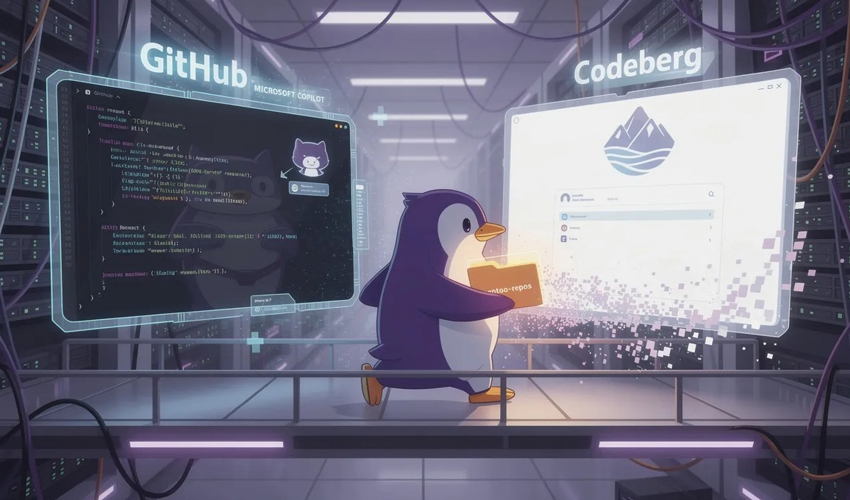
Gentoo Charts a New Path: Moving Away from GitHub Toward Codeberg
Ignite Your Next Career Move
Save up to 75% in celebration of Lunar New Year!Renew Your Skills. Accelerate Your Future.Offer ends February 24. SAVE NOW
The post Ignite Your Next Career Move appeared first on Linux.com.
GOG Moves Toward Native Linux Support: A Major Shift for DRM-Free Gaming